
Region
Victoria Falls & Livingstone
Mosi-oa-Tunya from the Zambian bank, a walkable colonial-era town, and the best-connected corner of the country.
Photo: Matti Blume, CC BY-SA 4.0, via Wikimedia Commons
Victoria Falls and Livingstone form the corner of Zambia that most visitors see first, and with good reason. It has an international airport, a compact town you can cross on foot, a national park on the edge of that town, and the Zambian half of one of the largest waterfalls on earth — all inside about twenty kilometres.
On this page
Why start here
Victoria Falls and Livingstone sit close enough together to be treated as one destination, which is unusual in Zambia.
Zambia is a country of long distances and seasonal roads. This region is the exception: everything in it is close together, most of it is reachable on tar, and the airport is five kilometres from the town centre. If you have a week, or if this is a first African trip, starting here removes most of the logistical risk from the first few days.
It is also the one part of Zambia where the main attraction is not wildlife. The falls are a geological set piece, the Zambezi below them is one of the world’s serious whitewater rivers, and the town itself has a history worth an afternoon. Game viewing here is a bonus, not the point — for that, the Luangwa Valley and Kafue are where you go.
Getting to Victoria Falls and Livingstone
By air. Harry Mwaanga Nkumbula International Airport (IATA code LVI) sits about five kilometres from central Livingstone and roughly fifteen kilometres from the falls. Zambia Tourism gives the Lusaka–Livingstone flight as about one hour ten minutes.
By road from Lusaka. The drive is roughly 470 to 485 kilometres on the T1, which is tarred for its whole length. It is a long day, not a difficult one, and it is the single most-used self-drive route in the country.
From Botswana and Namibia. The Kazungula Bridge, 923 metres long, opened on 10 May 2021 and replaced the old Zambezi ferry crossing to Botswana. It has substantially changed how the Caprivi and Chobe circuits connect to Zambia.
From Zimbabwe. The Victoria Falls Bridge, opened on 12 September 1905, still carries road and rail traffic between the two countries. Its main arch spans 156.5 metres and the deck sits about 128 metres above low water.
What we do not publish here. Visa arrangements, border opening hours and park entry fees in this region change without notice, and a stale figure is worse than none. Check those with the operator or the relevant authority on the day. We will tell you what exists and where it is; we will not quote you a price that may already be wrong.
The falls from the Zambian side
The waterfall is inscribed by UNESCO as a single transboundary property under its combined name, Mosi-oa-Tunya / Victoria Falls. The full curtain is about 1,708 metres wide. Roughly three-quarters of that face lies in Zimbabwe, which is why the Zimbabwean side is often described as having the better panorama.
What the Zambian side has instead is proximity. The Knife-Edge Bridge takes you directly opposite the Eastern Cataract, close enough that in high water you will be soaked within a minute. The path down to the Boiling Pot puts you at river level in the gorge. And Livingstone Island and Devil’s Pool, on the very lip of the drop, are accessible only from Zambia.
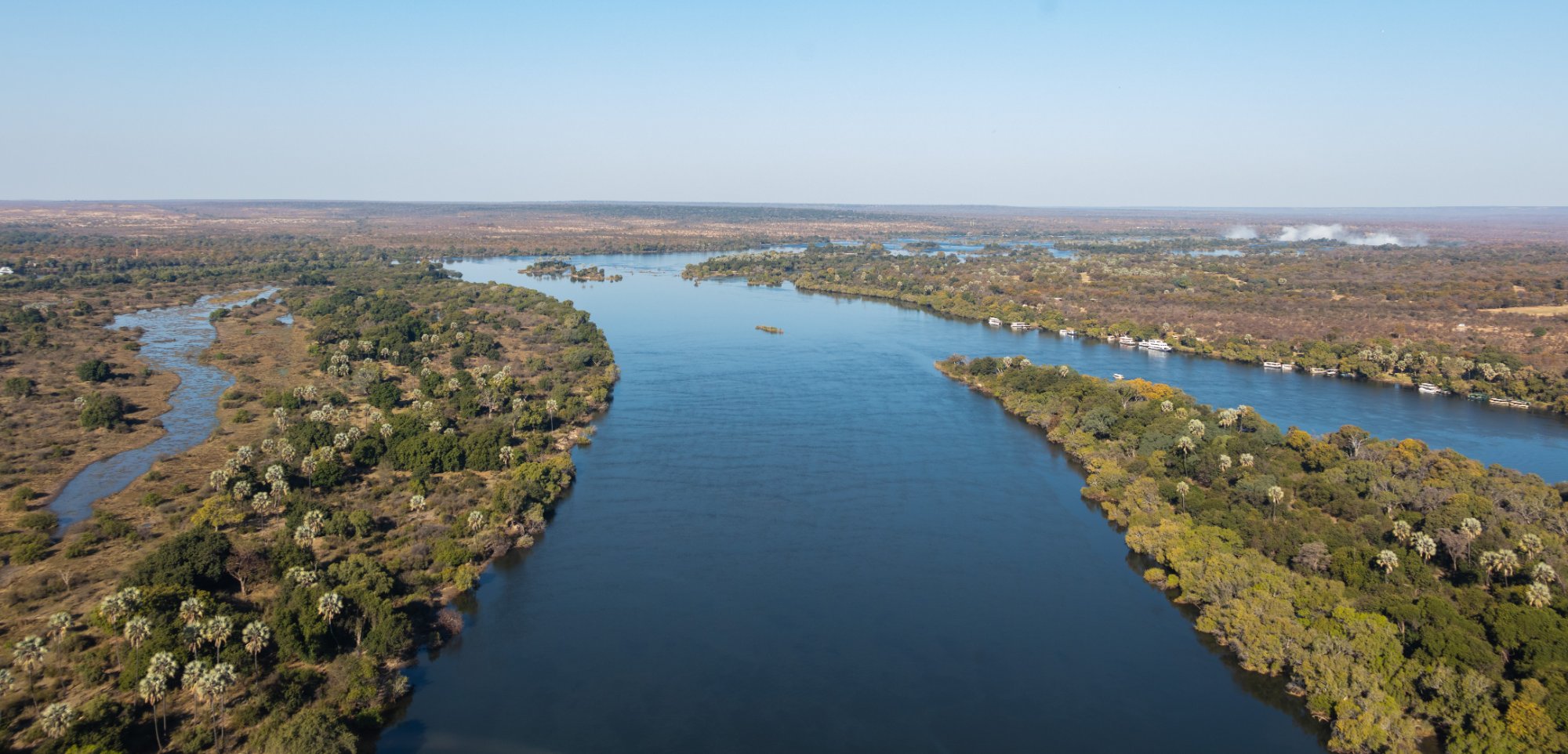
Photo: Diego Delso, CC BY-SA 4.0, via Wikimedia Commons
Livingstone town
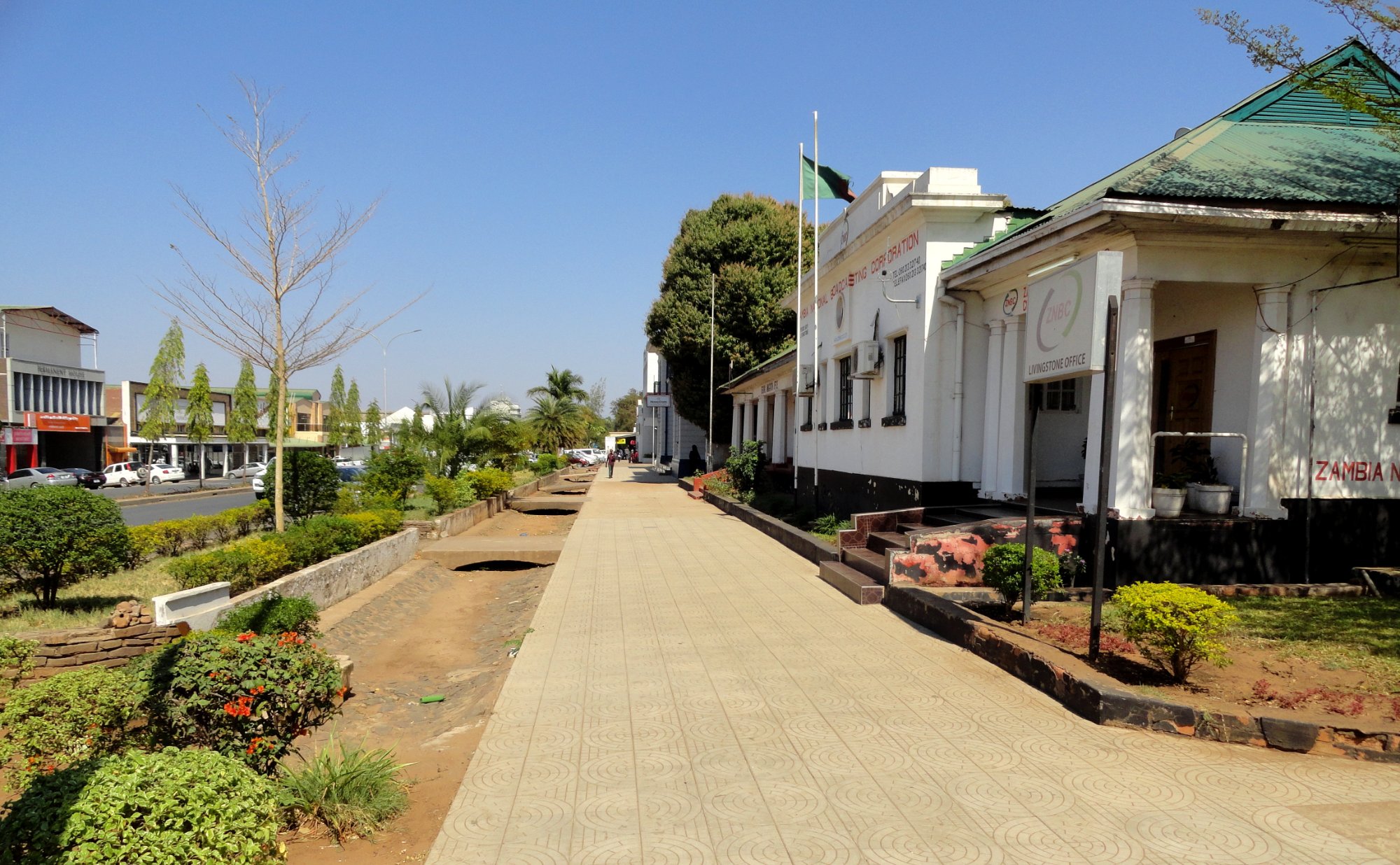
Livingstone was established in 1905, named after the missionary and explorer David Livingstone, and served as the capital of Northern Rhodesia until 1935. Its population was about 178,000 at the 2022 census. The centre is small, low-rise and walkable, with a spine of colonial-era shopfronts along the main road and the Livingstone Museum — Zambia’s oldest and largest — near the middle of it.
Most visitors sleep here or along the river road north of the falls, and treat the town as the base from which everything else is a short drive.
Mosi-oa-Tunya National Park
The national park that shares the falls’ Lozi name runs along the Zambezi upstream of them. Zambia Tourism gives its area as 66 square kilometres, which makes it small by Zambian standards — Kafue National Park is more than three hundred times larger. It holds a protected white rhino population and, unusually, no large predators, which is why guided rhino walks are possible here and not in most Zambian parks.
Treat it as a two-hour excursion rather than a safari destination. It is an excellent first sight of Zambian wildlife and a poor substitute for the Luangwa.
When to come
Victoria Falls and Livingstone run on the Zambezi’s flood cycle rather than on the safari calendar, and the two do not line up.
This region runs on the Zambezi’s flood cycle rather than the safari calendar, and the two do not line up.
| Roughly | The falls | The river |
|---|---|---|
| Feb – May | Building to peak flow, around April and May. Maximum spray, maximum noise, and viewpoints that can be entirely obscured by their own mist | Rafting operators run a shorter high-water section; the full run is generally closed around the peak |
| Jun – Sep | Falling steadily but still substantial. Generally the best balance of volume and visibility | The long low-water run opens up through this period |
| Oct – Dec | Lowest flow. The Eastern Cataract — the Zambian section — can reduce to a trickle or dry out altogether in some years | Peak whitewater season, and the window in which Devil’s Pool normally operates |
The trade-off, plainly. The months that give you the most water at the Zambian falls are the months that give you the least rafting and no Devil’s Pool. The months that give you Devil’s Pool and the full raft run are the months the Eastern Cataract may be nearly dry. You cannot have both on the same trip, and no operator can change that. Decide which one you came for.
Devil’s Pool typically operates from around mid-August to late December, and always subject to water level on the day. Rafting seasons are set by the operators and shift year to year with the flood.
Victoria Falls Livingstone guides
These are the individual guides to Victoria Falls and Livingstone.
Kazungula, on the Botswana border about seventy kilometres west of Livingstone, is covered within the region rather than as a separate guide for now.
Where to stay
Accommodation in Victoria Falls and Livingstone divides fairly cleanly by area.
Accommodation here divides fairly cleanly into town guesthouses and hotels in Livingstone itself, riverside lodges along the Zambezi upstream of the falls, and a small number of properties close to the entrance gate.
- Where to stay in Livingstone — how the areas differ and which suits which kind of trip
- Zambia accommodation — the national picture
- All Zambia destinations
Sources
Facts and figures on this page are drawn from the following. Where sources disagree we say so in the text.