Region
The Luangwa Valley
Where the walking safari began, and where Zambian game viewing is at its most concentrated.
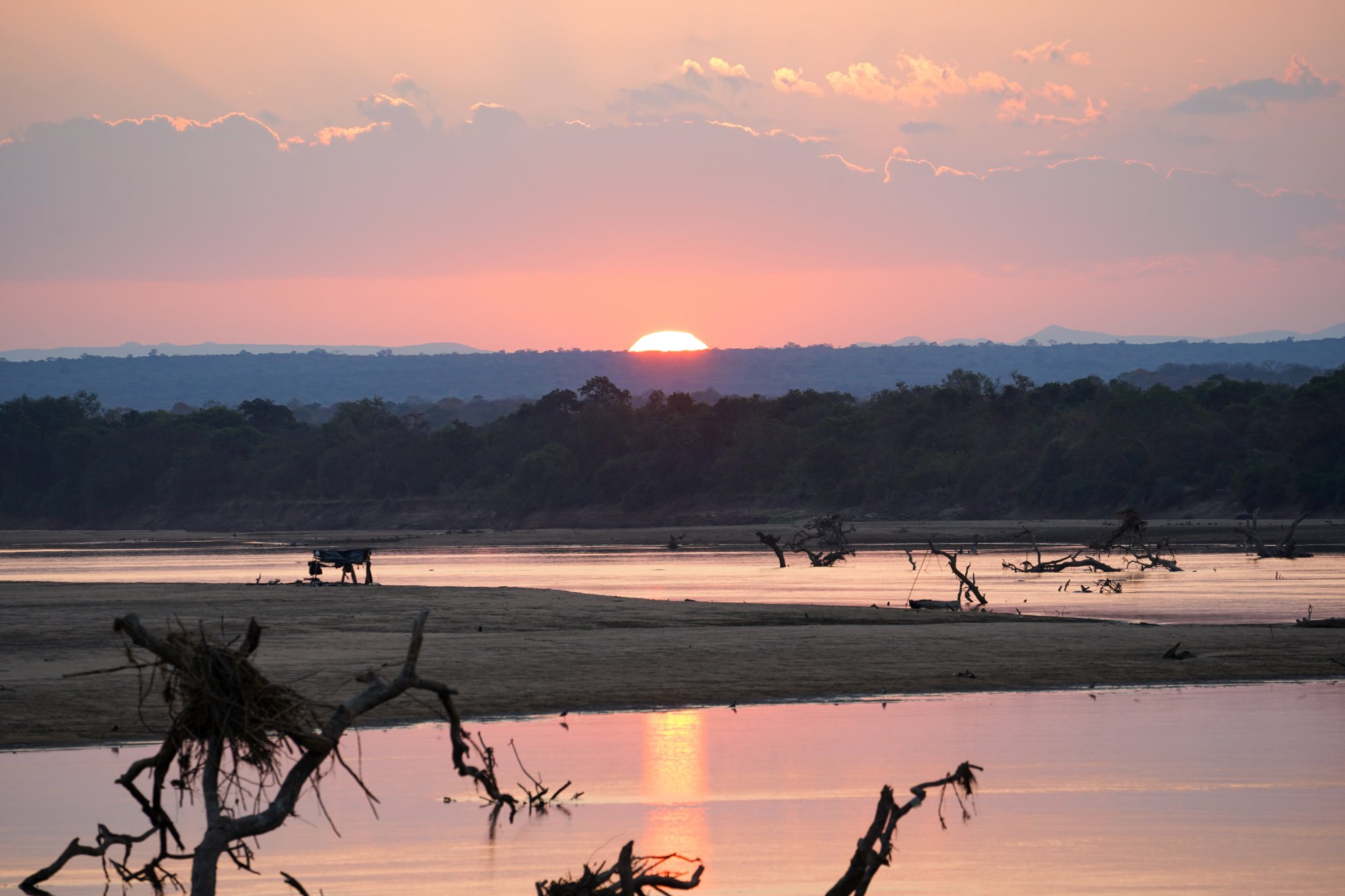
Photo: Timothy A. Gonsalves, CC BY-SA 4.0, via Wikimedia Commons
The Luangwa Valley holds the densest and most reliable wildlife in the country. The Luangwa is a tributary of the Zambezi running down a rift valley in eastern Zambia, and the corridor of parks along it holds the densest, most reliable wildlife in the country. It is also where the guided walking safari was invented, and that is still what the valley does better than anywhere else.
South Luangwa National Park
South Luangwa covers about 9,050 square kilometres along the river’s eastern bank, and it is the park most Zambian safari itineraries are built around. The river meanders across a broad floodplain, constantly cutting new channels and abandoning old ones as oxbow lagoons, and those lagoons are what concentrate the game as the dry season advances.
Leopard are unusually visible here. Elephant, buffalo, hippo and crocodile are abundant. Three subspecies found principally in this valley — Thornicroft’s giraffe, Cookson’s wildebeest and Crawshay’s zebra — give it a species list that does not quite match anywhere else.
The walking safari tradition here dates to the work of Norman Carr in the mid twentieth century, and the valley’s small bush camps are still built around it. Night drives, which are not permitted in every African country, are standard.
North Luangwa National Park
North Luangwa is about 4,636 square kilometres and is run on a deliberately restricted basis: very few camps, very few visitors, and much of the park closed to general access. It holds Zambia’s only black rhino population, reintroduced from 2003 after the species had been eliminated from the country.
The black rhino here live in a protected zone that is not open to tourism, and the population is small. Visiting North Luangwa is not a rhino-viewing trip and no operator can responsibly promise a sighting. Go for the walking and the emptiness; treat anything else as a bonus.
Luambe and Lukusuzi
Two smaller parks sit in the Luangwa Valley between and beside the main pair.
Two smaller parks lie in the valley between and beside the two main ones. Luambe sits on the river between South and North Luangwa; Lukusuzi is on the escarpment to the east. Both are very lightly developed and are for travellers who already know the valley rather than first-time visitors.
When to go
The Luangwa Valley has the sharpest season of any Zambian region.
The Luangwa has the sharpest season of any Zambian region. From roughly June to October the valley dries, game concentrates on the river and the lagoons, and this is the classic safari window — September and October are the peak, and also the hottest. From about November to April the rains arrive, the black-cotton roads become impassable, and a large proportion of bush camps close for the season. Some lodges stay open through the green season for birding and boat access.
Getting to the Luangwa Valley
- By air. Mfuwe International Airport serves the valley and is the standard arrival point, with scheduled flights from Lusaka. Camps transfer from there.
- By road. The Great East Road runs from Lusaka to Chipata, and from Chipata a road runs north to Mfuwe. This is a long drive and the final section is not a trunk road.
- Chipata, the regional centre, was formerly named Fort Jameson and is the last town with full services before the valley.
How long to give the Luangwa Valley
Four nights is the working minimum in the Luangwa and six is better, because the valley rewards settling in. A common shape is three nights at a main lodge near Mfuwe followed by three at a bush camp deeper in, which gives you both the accessible river loop and the walking country beyond it.
Who the Luangwa Valley suits
Almost everyone, which is why it is the default Zambian safari. It suits first-time visitors because the game viewing is reliable, and it suits experienced ones because the walking and the guiding are as good as anywhere in Africa. Photographers do particularly well here in the late dry season, when animals concentrate on the remaining lagoons.
What the Luangwa Valley is not
It is not a year-round destination. From roughly November to April a large proportion of the valley closes, the roads become impassable and the camps that stay open operate very differently. It is also not a self-drive region for the unprepared: the road in from Chipata is long and the tracks inside the park are seasonal.
Where to go next
- Lower Zambezi & Lake Kariba — the classic pairing with the Luangwa
- Bangweulu & the Central Wetlands — north-west of the valley
- Zambia safaris and tours — including walking safaris
- All Zambia destinations
- Zambia itineraries — how this region fits into a route
- Where to stay in Zambia
- Travel planning — seasons, flights and getting around
Sources
Facts and figures on this page are drawn from the following. Where sources disagree we say so in the text.